Combo Bounce House Rental vs. Standard: Which Is Best for Your Event?
Picking the right inflatable for a party sounds simple until you start looking at options. A standard bounce house, often called a jumper rental, is iconic and easy to understand. A combo bounce house rental adds a slide and sometimes more, promising bigger thrills. People ask me weekly which one fits their event, and the right answer changes with space, ages, budget, and how you want the day to flow. After a decade of scheduling deliveries for everything from toddler playdates to school carnivals, here is how I help clients choose with confidence.
What you actually get with a standard bounce house
A standard bounce house rental focuses on free play. Picture a 13 by 13 foot or 15 by 15 foot inflatable with a single entrance, four mesh sides, and a simple floor. Most standard models cap at 6 to 8 kids at a time, depending on age and weight. The footprint is compact, which is why these are workhorses for backyard party rental setups where lawn space is limited or slopes make layout tricky.
The beauty of a basic bounce house is how forgiving it is. Kids rotate in and out, invent games, and burn energy without a learning curve. If your event has mixed ages or you are not sure how many will attend, a standard jumper keeps things moving without bottlenecks. From a crew standpoint, setup is quick, usually 15 to 20 minutes with one power circuit, and most fit through standard gates. For clients who care about price, standard bounce house rental prices tend to be the lowest among inflatable rental options, which leaves margin for extras like a cotton candy machine or a bubble station.
What defines a combo bounce house
A combo bounce house rental combines a bounce area and a slide, often with a basketball hoop or obstacle pop-ups. The most common footprints are in the 13 by 25 to 15 by 30 foot range, and heights vary from 13 to 16 feet. The slide can be inside or external, single lane or dual lane. Some combos are wet dry slide rental models, which means you can run the slide with a hose attached in summer or dry the rest of the year.
Parents like combos because they create a natural rhythm. Kids bounce for a bit, climb, slide, then repeat. Throughput improves during peak moments because a slide exit moves kids along, especially if you use a brief line. Combos also scale for a wide age range. A 5 year old will treat the slide as an adventure, while a 10 year old uses it for lap races. You can keep the entire party focused on one inflatable without adding separate attractions.
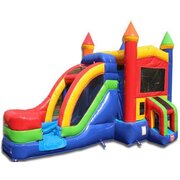
Where a combo shines, and where it does not
Combos win when you want one centerpiece activity that feels like more than a jump box. If your birthday party rental is for ages 4 through 10, the combo keeps siblings and friends of different sizes equally engaged. Family reunions also benefit because older kids tend to supervise themselves on the slide, which lets the little ones bounce safely on the floor. For camps or after-school events with a steady crowd, dual lane combos move kids faster with less line drama.
The downsides are practical. Combos need more level space, often another 8 to 12 feet of length compared to a standard. Slide heights push overall height near tree limbs or eaves. The climb ladder can be tough for very small children if the angle is steep. And combo models run higher on price, sometimes 30 to 60 percent above a basic jumper. If you are already renting tables, chairs, and a concession stand, that upgrade can push you past budget.
When a standard bounce house is the smarter play
I suggest a standard inflatable for toddler-heavy groups, tight yards, or short events where you want low complexity. When the guest list skews 2 to 6 years old, a toddler bounce house rental with a lower step and open front works beautifully. Parents can see everything, and the play pattern is gentler. For living situations like townhomes or narrow side yards, a 13 by 13 is often the only safe fit. And if you only need a two hour window of entertainment before a cake smash, the simplicity of a standard jump house makes setup and takedown painless.
Some school and church fundraisers also prefer standard units when they plan to add an inflatable obstacle course rental or inflatable slide rental as separate stations. In that case, the bounce house acts as the baseline activity while the other pieces handle line-busting.
Space, power, and ground rules that matter more than model choice
Nine times out of ten, the yard dictates the best inflatable. Before you fall in love with a giant water slide rental or a showy combo, grab a tape measure. Clear, level space is the nonnegotiable. Most companies ask for a 3 foot buffer on all sides for stakes and blower clearance. That means a 15 by 15 bounce house needs about 21 by 21 feet. A common combo at 15 by 28 feet needs roughly 21 by 34 feet. Height is equally important. Overhead clearance must be clear of branches, string lights, and roof edges. A good rule is at least 2 feet of clearance above the highest point.
Power is the next limiter. Standard blowers draw 8 to 12 amps on a dedicated 110V household circuit. Some larger wet dry slide rental combos use two blowers, which requires two separate circuits that are not sharing load with appliances. If you do not have reliable outdoor outlets, a quiet generator might be necessary. Factor that into party equipment rental budgeting.
Ground surface decides how the crew will secure the unit. Grass with stakes is best. Turf and concrete require sandbags or water barrels, which add weight and setup time. If the surface slopes, crews can sometimes shim with foam blocks, but they cannot fight gravity. If you plan a backyard party rental on a hill, a standard bounce house with a lower profile sits more safely than a tall slide.
Budget reality, and what prices often look like
Pricing varies by region, season, and the bounce house rental company you choose. That said, the ranges below reflect what I see across many markets.
- Standard bounce house rental prices: typically 120 to 220 dollars for a weekday or 160 to 300 dollars for a peak Saturday, for a 4 to 6 hour rental. Larger 15 by 15 models sit toward the higher end.
- Combo bounce house rental prices: often 220 to 350 dollars on weekdays or 280 to 500 dollars on peak weekends, with dual lane or wet dry models priced higher. Add 20 to 50 dollars for water use to cover wear and extra cleaning.
- Water slide rental prices: dry slides start around 250 to 450 dollars, while a medium single lane water slide can range 300 to 600 dollars. A giant water slide rental with a pool, 18 to 22 feet tall, can run 500 to 1,200 dollars depending on market demand.
- Add-ons: generators range 75 to 150 dollars, delivery distance surcharges can add 25 to 75 dollars, and set delivery windows or late pickups sometimes carry fees.
If your budget is tight, choose a standard bounce house and add a low-cost yard game like cornhole or a bubble machine to stretch the experience. If budget allows a combo but your yard barely fits it, ask your inflatable rental provider for an internal slide combo. It gives slide fun without the extra footprint of an external slide.
Safety, supervision, and what separates good operators from risky ones
You can rent the perfect inflatable and still have a rough day if safety is loose. A solid operator sets expectations before arrival and again on site. They will ask for age ranges, confirm ground type, and require a responsible adult to supervise. The rules are not complicated. Keep similar ages together. Limit the headcount inside. No flips, no toys or drinks, and no climbing the walls. A 5 minute safety briefing for parents solves most problems.
Look for visible anchors at every corner, blowers bagged or screened, and mats at entrances. If wind gusts approach the posted manufacturer limit, usually 15 to 20 mph, pause the device. For water use, insist on GFCI-protected outlets and a dry blower area. If you are weighing two companies, pick the one that talks you out of a risky setup. The best bounce house rental company will tell you no if the yard is not safe, then help you find an alternative that is.
I remember a backyard party, narrow lawn, full shade, fence tight to the house. The family wanted a combo to thrill a group of 9 year olds. We measured, then switched to a 15 by 15 standard and brought a separate inflatable slide rental that fit the side yard. It looked less impressive than a single big combo but ran safer and handled the crowd better. The parents thanked us for the redirect when the wind picked up later that afternoon.
Water or no water, and how seasons shape the choice
Water changes everything. In hot months, a combo with a detachable pool turns a normal party into a full event. Kids stay longer, lines form more politely, and parents plan around swimsuits and towels. A wet dry slide rental option lets you switch back to dry use in spring and fall. If you choose water, expect a longer cleanup and dryer times. Communicate hose access and drainage so the crew can route runoff away from patios and flower beds.
For cooler seasons, skip the water and select features that add play depth without moisture. Internal obstacles, pop-up pillars, basketball hoops with soft balls, and inflatable party rentals dual lane dry slides give the energy boost you want. For mixed indoor and outdoor events at schools or gyms, standard jumpers and obstacle course rental sections are usually dry only, which simplifies logistics.
Age bands, capacity planning, and preventing the dreaded line
Think about who is coming, not just how many. A kids party rental for ages 3 to 5 thrives on free play, soft climbs, and low entrances. Toddler combos are perfect here, with shallow slides and open fronts. For ages 6 to 9, a dual lane combo beats a single lane because head-to-head racing trims lines. Ages 10 to 12 are the sweet spot for mid-size water slide event rental company near me rental models or modular combos with taller slides. Teens prefer speed, so consider an inflatable obstacle course rental with a wide race lane instead of a traditional bounce house.
Capacity across a four hour event depends on rotation. With supervision and short turns, a 15 by 15 can entertain 30 to 40 kids comfortably. A combo increases that by about 20 to 40 percent because of the slide exit and faster cycles. For school carnivals with hundreds of attendees, one combo will bog down. Add a second attraction that uses different muscles, like a 30 to 40 foot obstacle, to thin the line.
Logistics that save headaches on event day
Delivery crews want access, power, and certainty. Gates should be at least 36 inches wide for standard units, 48 inches for some combos. Clear the path of toys, hoses, and pet waste. Dogs should be secured. If parking is tight, reserve a curb spot to keep dolly runs short. Give your provider a map or photos of the yard, plus any sprinkler head locations. Ask what time they will arrive and whether they will stake or sandbag. Good communication cuts setup time by half.
A word on rain and wind policies. Read them before paying the deposit. Many party rental companies allow rescheduling if winds exceed safe limits or steady rain threatens electrical safety. Do not try to push through unsafe weather. Most crews are flexible if you decide early in the morning, before trucks roll.
A quick side by side: when each option fits best
- Choose a standard bounce house rental if your space is tight, the group is mostly ages 2 to 6, you want the lowest price, or you plan to add a separate inflatable obstacle course rental or slide to spread out the crowd.
- Choose a combo bounce house rental if you want one centerpiece that keeps ages 4 to 10 engaged, you have at least 21 by 34 feet of level space with overhead clearance, you can supervise a slide line, and your budget covers the price bump for more features.
How to evaluate a provider, not just the inflatable
The best equipment still needs a reliable team behind it. Start with how the company handles your inquiry. Clear answers on sizing, power, and safety signal professionalism. Ask for recent photos of the actual unit, not just catalog art. You want to see anchor points, netting condition, and slide seams. Confirm insurance and permits if your event is in a park. Municipalities often require a certificate of insurance listing them as additional insured.
References matter. If a neighbor had a great experience with a local party rental operator, that is worth more than a dozen stock reviews. For large events, ask how many crews they run and whether they can support same day service calls. I have seen excellent gear spoiled by slow response when a GFCI tripped or a hose coupling leaked. A responsive team turns small hiccups into non-issues.
The alternative path: build stations instead of one centerpiece
Sometimes neither a standard nor a combo alone solves the plan. If your budget allows, pair a standard bounce house with a short inflatable slide rental or a compact 30 foot obstacle. The combined footprint can equal a big combo but splits the line into two. For high school festivals, swap the jump house entirely for an inflatable obstacle course rental and a competitive game like an axe throw inflatable. For water-heavy summer block parties, a giant water slide rental plus a separate toddler bounce house rental creates safe fun across ages without mixing big kids and small kids.
Two smaller attractions often cost about the same as a premium combo, especially if delivery is already included. Ask your provider to price packages. Many will bundle for less than the sum of parts, especially midweek.
A simple site checklist to finalize your choice
- Measure clear, level space and overhead clearance. Add buffers for stakes and blowers.
- Count accessible power circuits, and note distances to outlets. Plan for GFCI on water units.
- Match the inflatable style to your age bands, with a plan to rotate kids in short turns.
- Confirm delivery access, gate widths, and ground type for anchoring. Share photos with your provider.
- Lock down supervision. Assign adults in shifts, post simple rules, and keep water away from blowers.
Real numbers from real backyards
Here are three scattershot examples that mirror common client situations.
A backyard in a 1950s neighborhood, 20 by 22 feet of grass between patio and fence, one GFCI outlet, ages 3 to 6. We set a 13 by 13 bounce house for 185 dollars on a Saturday. The family added a bubble machine for 25 dollars. We staked at four corners and added two sandbags where irrigation lines prevented stakes. The kids cycled happily with no lines.
A cul-de-sac block party, corner lot, 35 by 40 feet open space, two circuits, mixed ages 4 to 12. We placed a 15 by 28 wet dry combo as dry for the first hour, then switched to water when it warmed up. Total rental was 365 dollars plus 25 dollars for water use. A volunteer parent ran the slide line with a 30 second cadence per child. Throughput stayed steady even with 40 kids.
A school spring fair with 400 attendees, field space abundant. We proposed two attractions rather than one combo: a 40 foot inflatable obstacle course rental and a 15 by 15 bounce house. Total rental 795 dollars, which matched a single premium dual lane combo plus tax. Lines split naturally. Little kids gravitated to the bounce house while older students raced the obstacle. The PTA chair later said the split saved the day.
Final guidance, distilled
If your yard is compact, your group is little, or your budget is firm, a standard bounce house rental is almost always right. If you can spare the space and want one piece that feels like a small playground, a combo bounce house rental earns its keep with slide-driven excitement and higher throughput. Layer in water only when heat and drainage make sense, and keep a close eye on power and supervision no matter what you book.
When you talk to your inflatable party rental provider, bring measurements, ages, and a clear picture of your day. A reputable bounce house rental company will steer you to the safest, most cost effective option, even if that means recommending a different piece like an inflatable slide rental or a compact obstacle over the flashiest combo on the website. That judgment, plus your understanding of how your guests play, is what turns a good event into a great one.